Developer tools / Localization
ReRune
ReRune lets software teams own their product copy: edit app text and translations, tailor it for different audiences, and publish updates without a new release. ROE Check-it replaced spreadsheet handoffs with a shared workflow.
Direct BasalBit contribution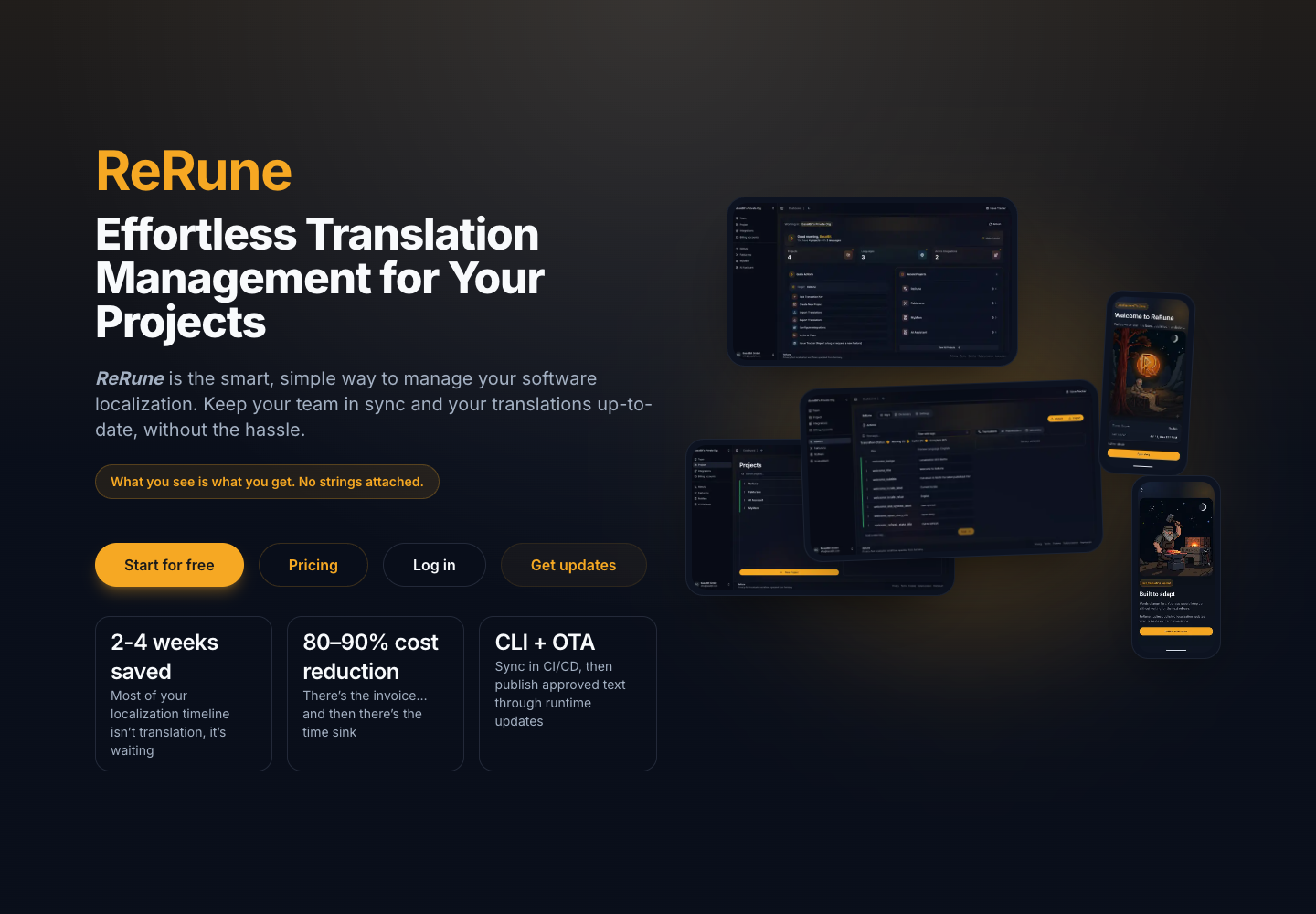
- Project area
- Developer tools / Localization
- Built for
- Product, engineering, and localization teams
- Technology
Context
- Translation management for software teams shipping web, mobile, and cross-platform apps
- Combines editing, ML and AI assistance, audience variants, CLI/API sync, and over-the-air (OTA) publishing
- Built so teams can change what their app says without waiting for the next release
Localization slows down when the source of truth fractures. Keys live in the repository, terminology in people's heads, progress in spreadsheets, and corrections wait for the next software release.
ReRune joins those parts. Source text, translations, audience variants, dictionaries, product context, repository sync, and publishing stay in one system. Drafts can be previewed before they go live, and earlier published text can be restored.
Product video
From an approved dashboard edit to updated app text in 14 seconds
What the product delivers
- Shared workspaces with projects, languages, team permissions, and translation status
- Translation keys with placeholders, plurals, metadata, and project dictionaries
- Machine and AI translation through DeepL and OpenRouter, using project context, with every suggestion reviewed before it is published
- Audience variants: one key can show different wording for an A/B test, a white-label brand, or a Free or Pro plan, with the main text as fallback
- CLI, API, and CI/CD workflows that keep translation files in sync with the repository, plus an MCP server that lets coding agents such as Claude Code, Codex, or Cursor work with projects
- OTA SDKs for React, React Native, Angular, Flutter, Android, and iOS that update app text without a new app build
- Staging previews of drafts on test builds before publishing, and a publication history for restoring earlier published text
Proof in ROE Check-it
ROE previously managed localization in large Excel spreadsheets passed between colleagues. That made ownership, progress, and consistency hard to see. During the pilot, ReRune gave technical and nontechnical contributors one shared workspace, with BasalBit handling setup and onboarding.
The result was a clearer process with less manual coordination. ROE also reports time saved and translations that became more consistent and reliable.
- One source of truth instead of spreadsheets passed between colleagues
- Nontechnical colleagues can contribute without editing source files
- Project dictionaries and context make wording more consistent
- Key and language coverage make readiness visible before release
Delivery model
A key can move from the repository into a shared project, pick up terminology, context, and audience variants, pass review, and return through the CLI or API. In apps with a ReRune SDK, the approved text can be previewed on a staging build, published over the air, and rolled back if needed.
We automate the movement and the repetitive suggestions. Ownership, review, and the decision to publish remain visible to the team.
ReRune's server and cross-platform CLI are written in Go. Its SDKs cover React, React Native, Angular, Flutter, Swift for iOS, and Kotlin for Android, so the product is maintained across the same delivery environments it supports.
Our contribution
ReRune is owned and built by BasalBit. It brings together our work in SaaS, governed AI assistance, developer tooling, and mobile runtime infrastructure.
Project context & sources
ReRune is built by BasalBit and used in ROE Check-it. The links below cover the product, its video walkthroughs on YouTube, the ROE implementation, and the Check-it application.